
Best Photography Spots in Washington, D.C.
Where to make great photographs in Washington — the monument reflections, the Tidal Basin blossoms, the Capitol and Lincoln axis, Georgetown's waterfront, hidden rooftops and the golden-hour and blue-hour routes that tie them together.

Photo: Hester Qiang / Unsplash
- ✓The Lincoln Memorial Reflecting Pool gives the city's signature shot — the Washington Monument mirrored in still water — and it is best at dawn, before the wind and the crowds.
- ✓The Tidal Basin is the most photographed water in the city: the Jefferson Memorial across the basin, framed by cherry blossoms in spring and lit gold at sunset year-round.
- ✓For the classic Capitol-down-the-Mall and Lincoln-down-the-axis compositions, a longer lens compresses the marble beautifully — pack something past 70mm.
- ✓Blue hour, the twenty minutes after sunset, is the magic window: the monuments switch their floodlights on while the sky still holds colour, and the marble glows against deep blue.
- ✓Most of the best spots are free, public and open late — but tripods can be restricted inside museums and some federal interiors, so verify the rules where it matters.
A city built to be photographed
Washington is one of the easiest great cities in the world to photograph, because it was deliberately composed. Pierre L'Enfant laid the capital out as a set of sightlines — long diagonal avenues, a monumental core on a single axis, white stone against green lawn — and the result is a place that gives up clean, balanced pictures almost wherever you point the camera. You do not need to hunt for compositions here so much as turn up at the right light and let the geometry do the work.
That said, the difference between a flat midday snapshot and a photograph worth keeping in Washington is almost always the hour. The marble of the monuments goes chalky and harsh under a high sun, the Mall fills with tour groups, and the heat haze flattens the long views. Shift the same scenes to the first hour after sunrise or the last hour before dark and the whole city warms, softens and empties. This guide is organised the way a photographer actually moves through DC — by the headline reflections and axes, then the Tidal Basin, the neighbourhoods and the rooftops, and finally the light itself.

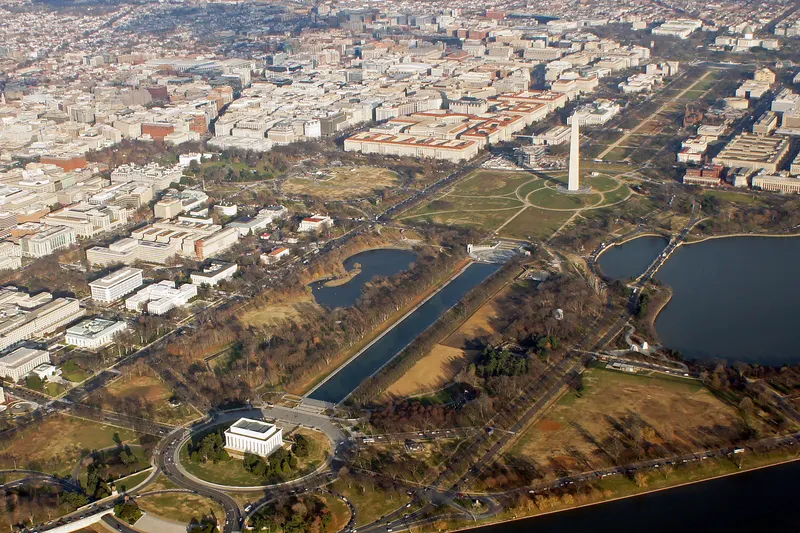

The headline shot: monument reflections and the Mall axis
The single most recognisable photograph in Washington is the Washington Monument doubled in the Lincoln Memorial Reflecting Pool. To get it cleanly you want still water, which means wind-free early morning far more reliably than evening — arrive at or just before dawn, stand at the Lincoln end, and shoot east down the pool with the obelisk reflected toward you. The same long basin works in reverse at sunset, with the Monument lit and the sky behind it, though the surface is rarely as glassy late in the day. A polarising filter helps cut glare on the water and deepen the sky either way.
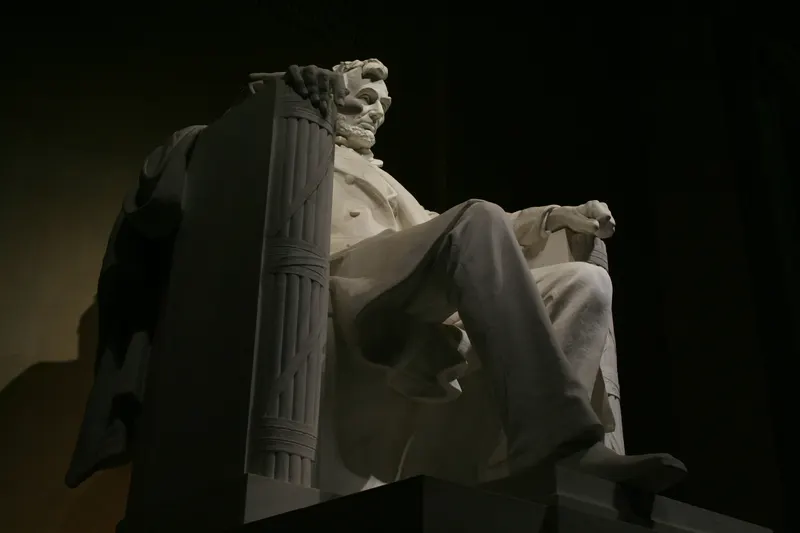
From the Lincoln Memorial steps you also get the grand westward and eastward axes: down the length of the Reflecting Pool toward the Monument and Capitol, and out over the Potomac. The Capitol itself photographs best from the west, looking back up the Mall with the dome rising over the lawn — a long lens (anything past 100mm) compresses the gravel paths and elm rows into a tidy, classical stack. For the Lincoln statue indoors, a fast lens and a steady hand beat a tripod, which is often restricted inside the chamber; come early and you may have Mr. Lincoln nearly to yourself.
- Lincoln Reflecting Pool at dawn — the Monument mirrored in still water; the quintessential DC frame.
- Capitol from the west Mall with a long lens — compress the lawn and elms under the dome.
- Lincoln Memorial steps — the eastward axis down the pool, and the Potomac view to the west.
- Inside the Lincoln chamber early — fast lens, no tripod needed; far fewer people before 8am.
- Bring a polariser for the water and skies, and pack at least one lens longer than 70mm.
The Tidal Basin: blossoms, the Jefferson and sunset
If the Reflecting Pool is the city's signature reflection, the Tidal Basin is its prettiest. The Jefferson Memorial sits low across the water on the south side, and the loop path around the basin gives you a constantly changing foreground of water, willows and — for one fevered week or two each spring — thousands of cherry blossoms. In bloom season the basin is the most photographed place in Washington and the most crowded; go at first light, when the water is calm, the low sun rakes warm across the petals, and you can actually find a clear foreground before the crowds arrive. Peak bloom shifts every year, so track the National Park Service forecast rather than booking blind.
Year-round, the Tidal Basin is a sunset spot. From the northwest edge near the paddle-boat dock you can line up the Jefferson Memorial with the sun dropping behind it; from the southeast the Washington Monument reflects in the water with the FDR and MLK memorials a short walk along the shore. Blue hour here is exceptional, because the Jefferson's dome lights up while the sky still holds colour and mirrors in the basin. A tripod and a slow shutter will smooth the water to glass — just bring a remote or use the timer, and watch the tide, which genuinely rises and floods parts of the path.
- Cherry blossoms at dawn — beat the crowds; the low sun warms the petals and the water stays calm.
- Jefferson Memorial from the northwest shore — line it up with the setting sun.
- Blue hour from the southeast — the lit dome mirrored in the basin against a deep sky.
- Pack a tripod for long exposures that glass the water — and mind the tide, which floods the path.
- Peak bloom moves yearly: verify the NPS bloom forecast before planning a blossom trip.

Neighbourhoods, gardens and the architectural eye
Step off the federal core and Washington offers a quieter, more textured kind of picture. Georgetown is the obvious one: the C&O Canal towpath with its low stone bridges, the Federal-era row houses on N and O Streets in their painted brick, the Key Bridge over the Potomac, and the waterfront where the Kennedy Center and the Watergate line up across the river at dusk. The cobbled Cady's Alley and the staircase from The Exorcist are cult favourites. Capitol Hill rewards a slow walk too — the pastel rowhouses, Eastern Market's red brick, and the long straight streets that frame the dome at their end.
For greenery and detail, two gardens stand out. The U.S. National Arboretum holds the National Capitol Columns — twenty-two Corinthian columns that once stood at the Capitol, now marooned dramatically in a meadow, unforgettable at sunrise or under spring azaleas. Washington National Cathedral, up on the city's highest hill, gives you Gothic stone, gargoyles and the loveliest stained glass in the city, plus a walled medieval-style garden and the broadest view in town from its tower climb. Both sit well off the Metro, so factor in the travel — but both reward a photographer far more than the crowded core.
- Georgetown — the C&O Canal towpath, painted row houses, Key Bridge and the waterfront at dusk.
- Capitol Hill — pastel rowhouses and streets that frame the dome; Eastern Market's brick.
- National Arboretum — the marooned Capitol Columns in their meadow; spectacular at sunrise.
- Washington National Cathedral — Gothic stone, gargoyles, stained glass and the Bishop's Garden.
- The Smithsonian Castle and the Hirshhorn give striking architectural foregrounds on the Mall itself.
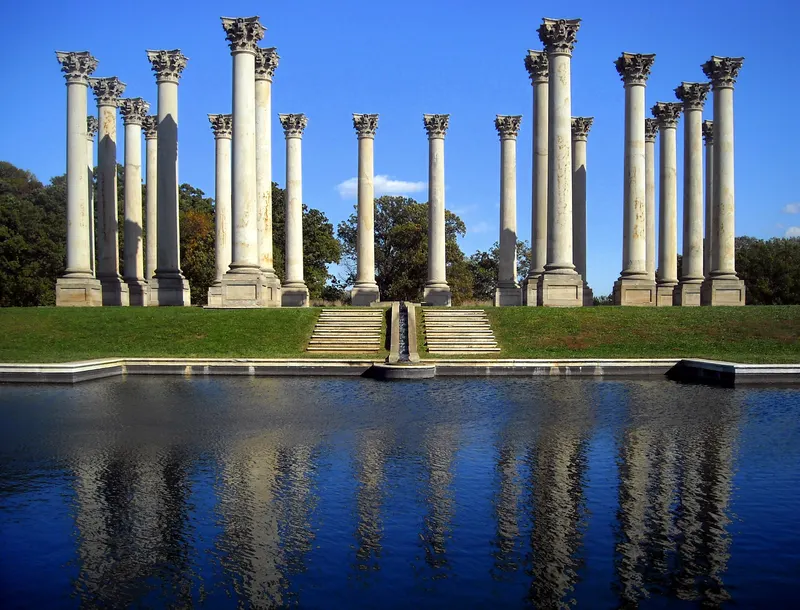 U.S. National Arboretum
The Capitol Columns and azalea hillsides — a photographer's favourite off-Mall stop.
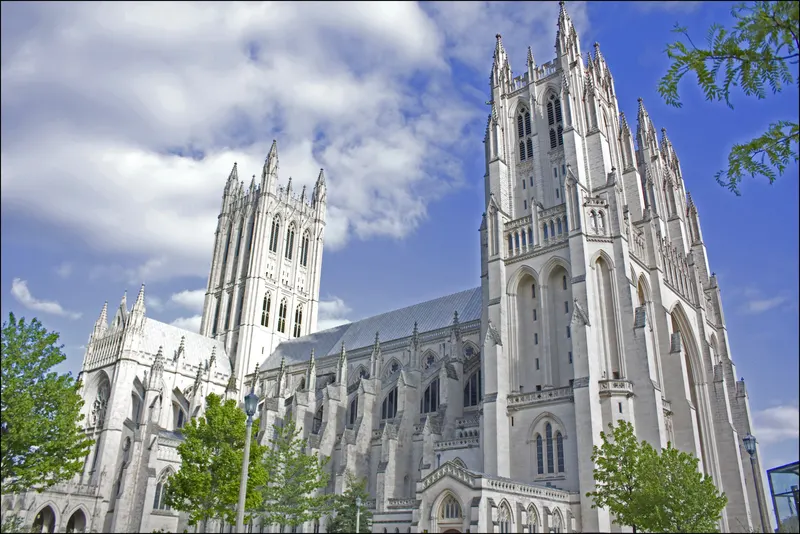 Washington National Cathedral
Gothic detail, stained glass and the city's broadest view from the tower.
 Washington DC hidden gems
More quiet corners and architecture that reward a camera away from the crowds.
Rooftops, the night route and getting the light right
Washington has a strict height limit — by law no private building may tower over the monuments — so there are no skyscraper observation decks here. Elevation comes instead from rooftop bars and a few cultural perches. Several downtown and 14th Street rooftops frame the Washington Monument over your drink, and the free roof terrace of the Kennedy Center gives a clean, elevated sweep over the Potomac, Georgetown and the Watergate, magnificent at sunset — now the surest free high vantage in the centre. (The Old Post Office tower, a National Park Service observation deck separate from the building's hotel use, long offered another such view, but it closed to the public in October 2025 with no reopening date.)
For the monuments at night, the city is genuinely at its photographic best. The Lincoln, World War II, Korean War and Vietnam memorials are floodlit and open through the night, and the crowds vanish after dark. Walk the western Mall as a route — Lincoln, then the WWII Memorial fountains, then the Tidal Basin — shooting at blue hour and into full dark with a tripod. The general rule for Washington is simply this: shoot the wide marble views at the edges of the day, save the interiors and gardens for soft overcast or early morning, and treat blue hour as the prize. Confirm tripod rules where you go — they are fine outdoors on the Mall but often restricted inside museums and federal buildings.
- Kennedy Center roof terrace — free, elevated and superb over the Potomac at sunset.
- Downtown and 14th Street rooftop bars — the Monument framed over a drink at dusk.
- The western Mall after dark — Lincoln, WWII and the Tidal Basin, floodlit and near-empty.
- Blue hour is the prize: lit marble against a colour-holding sky for about twenty minutes after sunset.
- Tripods: fine outdoors on the Mall, often restricted indoors — verify before you set up.

Practical notes for shooting in DC
A few logistics make a Washington photo trip far smoother. The summers are hot, humid and hazy, which softens the long views and tires you quickly, so spring and autumn are the photographer's seasons; winter gives crisp air and the cleanest distance shots of all. The monuments and Mall are open and lit at night, but use common sense after dark and stick to the well-trafficked, well-lit core. The Mall is enormous on foot — the Lincoln-to-Capitol axis is two miles — so plan your light around one zone rather than trying to sprint between sunrise spots.
On gear and rules: drones are effectively banned over the entire core of Washington (the city sits inside restricted airspace), so leave the quadcopter at home. Tripods and monopods are generally fine outdoors on the National Mall but frequently restricted inside Smithsonian museums, the Capitol and other federal interiors — and commercial shoots need permits — so check each venue's policy. None of this dampens the city for a traveller with a camera. Pick your hour, pick your axis, and Washington will hand you a clean, monumental photograph almost every time.

Related guides
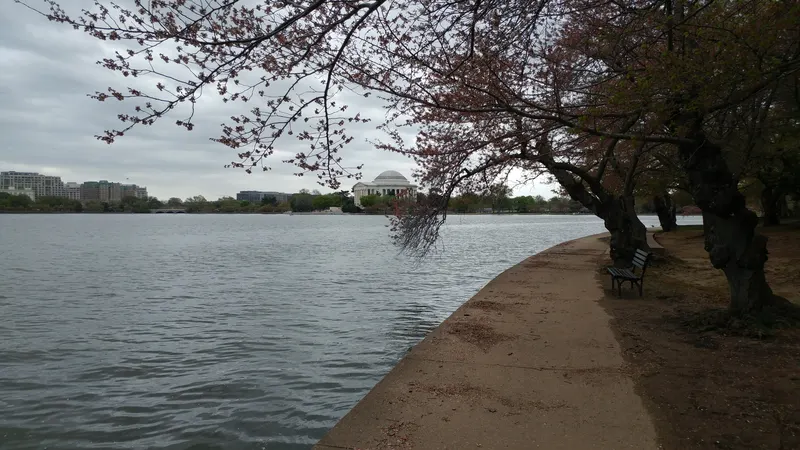
Tidal Basin Guide
Walk the Tidal Basin in Washington, D.C. — the Jefferson, FDR and Martin Luther King, Jr. memorials around its shore, the famous cherry blossoms, the paddle boats, the best time of day to beat the crowds, and where to stand for the sunrise reflection shot.
Read guideU.S. National Arboretum Guide
How to visit the U.S. National Arboretum in northeast Washington — the famous Capitol Columns, the azalea hillside, the Bonsai Museum and gardens, the transport reality of getting there, and when the detour is worth it.
Read guide
Washington, D.C. Monuments by Night
An atmospheric, sensible evening route through Washington's floodlit memorials — the Lincoln, the war memorials, the Tidal Basin loop and the Washington Monument — with self-guided and guided-tour options, and honest safety advice.
Read guideMore in Things to Do
6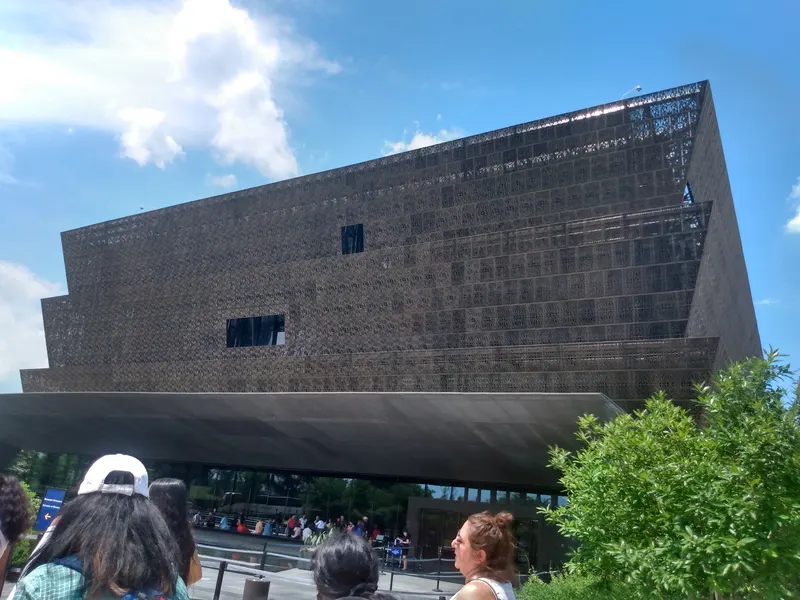
African American History Museum Guide
How to visit the National Museum of African American History & Culture on the Mall — the free timed-entry passes and how to get one, the deep underground history galleries, Sweet Home Café, the lines, how to pace an emotionally heavy visit, and the walk along the Mall.
Read guide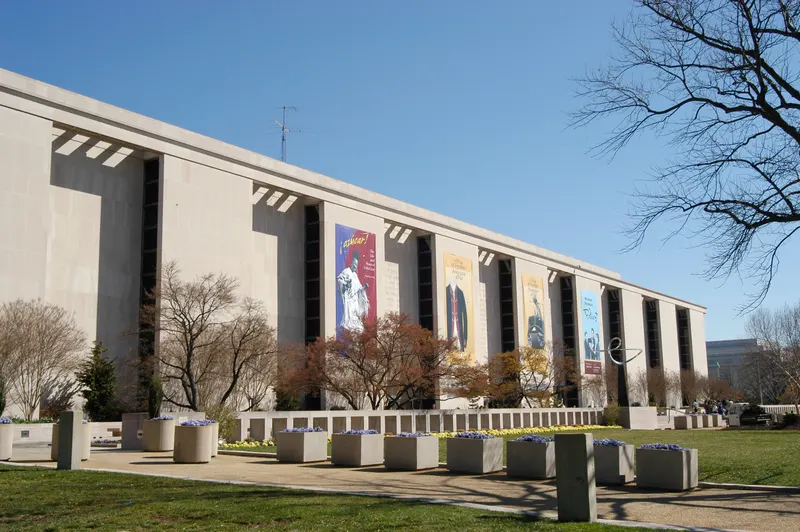
American History Museum Guide
How to visit the National Museum of American History on the Mall — the original Star-Spangled Banner, the First Ladies' gowns, the American presidency, the pop-culture icons, the food-court logistics, and how to time a visit around the school groups.
Read guide
Best Museums in Washington, D.C.
Washington has more world-class museums than any sane trip can hold, and almost all of them are free. This is a guide to the best museums in DC sorted by topic, age, ticket needs, location and rainy-day value — so you can choose two or three with confidence instead of trying to see them all.
Read guide
Best Things to Do in Washington, D.C.
A ranked first-trip shortlist of the best things to do in Washington, D.C. — from the National Mall and the free Smithsonian museums to a Capitol tour, the Tidal Basin and Georgetown — built so you can pick a handful and still feel you saw the city.
Read guide
Best Viewpoints in Washington, D.C.
Where to find the best views in Washington — the high monuments and free towers, the rooftop bars and cultural terraces, and the river and hilltop overlooks across the Potomac, ranked by how much effort each one asks.
Read guide
Best Washington, D.C. Tours
When a tour is genuinely worth it in Washington and when the city is better free and self-guided — monument night tours, bike and Segway loops, food and neighbourhood walks, official Capitol and government-building tours, and the day trips that need a coach.
Read guide