
Natural History Museum Guide
How to visit the National Museum of Natural History on the Mall — the dinosaur hall, the Hope Diamond and the gem collection, the mammals and ocean halls, a family-pacing plan, where to eat, and how to see the highlights without museum fatigue.
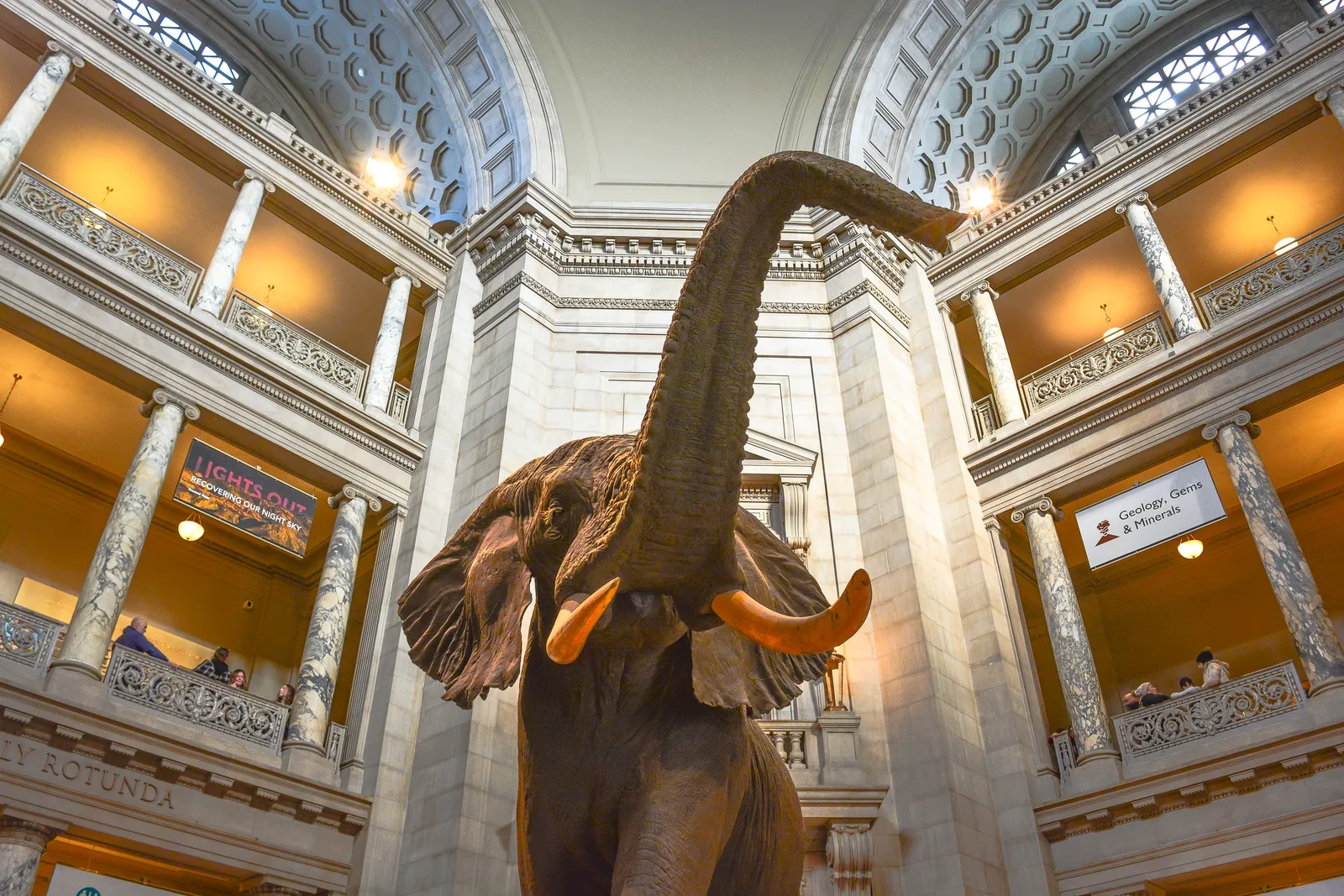
Photo: Syed07 / Wikimedia Commons · CC BY 4.0
- ✓Free admission, every day, and usually no ticket needed — walk in off the Mall after a quick security check.
- ✓The headline draws are the dinosaur hall, the Hope Diamond and the gem-and-mineral collection, and the giant elephant under the Rotunda dome.
- ✓The ocean hall, the mammals hall and a live insect zoo round out a museum that easily fills a half-day with children.
- ✓Pick three or four highlights rather than every gallery — this is one of the most-visited natural history museums in the world for good reason, and it's vast.
- ✓Hours and any temporary closures vary — confirm on the official site before a tight plan.
Dinosaurs, diamonds and a giant elephant
Walk in off the National Mall and the first thing you meet is the Rotunda, a soaring marble hall under a dome, with a towering African bush elephant mounted at its centre — one of the most photographed sights in any Smithsonian building. It is a fitting overture, because the National Museum of Natural History is a museum of superlatives: among the most-visited natural history museums on earth, holding a colossal collection that ranges from dinosaur skeletons to the most famous gemstone in the world.
For most visitors the museum comes down to three things: the dinosaurs, the diamonds and the sheer scale of the place. It is one of the Smithsonian's free museums, set on the north side of the Mall, and a near-automatic choice for families — children who tire of marble monuments come alive in front of a Tyrannosaurus skeleton or a wall of glittering minerals. As with every big Mall museum, the secret is restraint: choose a handful of highlights, see them well, and resist the urge to walk every hall.


Free entry and how to get in
Like every Smithsonian museum, admission is free, and in most periods you can simply walk in — no ticket required. You will clear airport-style security at the entrance, with bags screened, so travel light and allow a few minutes for the line, which can be long at peak times on the busy north side of the Mall. The museum is one of the easiest big draws to fit into a day precisely because it is usually walk-in.
That said, the Smithsonian adjusts its policies from season to season, and some special or temporary exhibitions can carry their own timed entry. Treat any rule you read in advance as a prompt to verify rather than a fixed fact: check the official visit page close to your trip for the day's hours, any timed-entry requirement for special shows, and which halls are open. Arriving early, near opening, is the single best way to beat both the security line and the school groups.
- Admission is free; most of the museum is walk-in with no ticket needed.
- Airport-style security at the entrance — pack light and allow time for the bag line.
- Some special exhibitions may use their own timed entry — verify before you go.
- Arrive near opening to beat the security queue and the midday school groups.
- Confirm hours and open halls on the official site before a tight plan.
The headline halls
The dinosaur hall is the natural starting point — a reimagined fossil hall that sets the giants of the deep past against the story of how life and the planet have changed over time, with a Tyrannosaurus among the stars of the room. From there, the gem-and-mineral collection is the other unmissable draw, and its centrepiece is the Hope Diamond, the deep-blue diamond wrapped in legend that draws a steady crowd to its rotating case; around it stretches a dazzling hall of gemstones, minerals and meteorites.
Beyond the two headliners, the museum's mammals hall presents animals from around the world in lifelike settings, and the ocean hall — built around a model whale suspended overhead — explores life beneath the sea across a sweep of geological time. There is a live insect zoo and butterfly experience for younger visitors, a hall on human origins, and rotating special exhibitions that often justify a return. You cannot see it all in one visit, and you should not try; pick three or four of these halls and give them the time they deserve.
- Dinosaur / fossil hall: the headline gallery, with a Tyrannosaurus and the deep-time story of life.
- Hope Diamond and the gem-and-mineral hall: the famous blue diamond amid gemstones, minerals and meteorites.
- Mammals hall: animals from around the world in lifelike dioramas.
- Ocean hall: a model whale overhead and the story of life beneath the sea.
- Live insect zoo and butterfly experience, plus a hall on human origins and rotating special shows.
A family-pacing plan
Natural History is one of the most child-friendly buildings in Washington, but its very size is the thing that catches families out — the temptation is to keep going until everyone wilts. A better plan is to lead with the dinosaurs and the gems, the two halls children remember most, take a deliberate snack-and-sit break, and then add just one more hall (the ocean or the insect zoo) before stopping. Three or four halls, well seen, beats ten halls half-seen.
Strollers are welcome, restrooms and water fountains are plentiful, and the open lawn of the Mall is right outside for a run-around when indoor stamina runs out. With younger children, aim for the first hour or two after opening, before the crowds and the school groups thicken — the same objects are far more enjoyable without a wall of people in front of them. Budget two to three hours for a focused visit, and treat a full half-day as the upper limit before fatigue sets in.
Food and avoiding museum fatigue
There is a café inside the museum for a quick refuel, but it is standard cafeteria fare at fair-not-cheap prices, like most museum cafés on the Mall — fine for a snack between halls, less so for a memorable lunch. For a better meal, the smarter move is to step off the Mall: Penn Quarter sits just to the north and is full of restaurants, or you can time your visit to eat before or after the lunch rush, when every museum café is at its busiest. Bring a refillable water bottle; fountains are everywhere and it saves both money and queue time.
Museum fatigue is the real enemy here, and it is entirely avoidable. The cure is to plan less, not more: choose your three or four halls in advance, sit down for ten minutes when you start to flag, and leave with energy to spare. Because the museum is free, there is no penalty for a short visit and no reward for a long, grim one — the people who enjoy it most are the ones who walk out before they are exhausted, not after.
- The in-museum café is serviceable cafeteria food — fine for a snack, not a destination meal.
- For a real lunch, walk north to Penn Quarter or eat before or after the rush.
- Bring a refillable water bottle — fountains are plentiful and the lines are long.
- Plan three or four halls, take a sit-down break, and leave before fatigue sets in.
Pairing it on the Mall
Natural History sits on the north side of the National Mall, next door to the National Museum of American History — which makes the two an obvious pairing for a single, low-walking day. The classic plan leads with Natural History in the morning, when the dinosaur hall and the gem rooms are at their quietest, breaks for a real lunch off the lawn, and finishes with American History's Star-Spangled Banner and pop-culture icons in the afternoon. From the steps of one you can practically see the other, so you spend the day looking at objects rather than crossing the city.
If you'd rather widen the day, the National Gallery of Art is also on the north side and also free, a few minutes east, and a calmer, more contemplative counterpoint to a morning among the dinosaurs. Whatever you pair it with, keep the museum in the middle of the day — indoor, air-conditioned, ideal for the heat or the rain — and save the monuments for the cooler edges, when the marble is at its best and the crowds have thinned.
Common questions
Is the Natural History Museum free? Yes — admission is free, like every Smithsonian museum, and most of it is walk-in with no ticket needed.
Do I need a ticket? Generally no, though some special exhibitions may use their own timed entry. Verify the current requirement before you go.
What are the must-sees? The dinosaur hall, the Hope Diamond and the gem-and-mineral hall, the giant elephant under the Rotunda, and the ocean hall.
How long should I plan? About two to three hours for a focused visit; a full half-day is the upper limit, especially with children.
Is it good for kids? Very — the dinosaurs, gems and live insect zoo make it one of the most child-friendly museums in the city.
When is it least crowded? Near opening, before the school groups and midday crowds arrive — the same objects are far better seen early.

Related guides

National Air and Space Museum Guide
How to visit the National Air and Space Museum on the Mall — the free timed-entry passes, the best galleries to prioritise, what the long renovation means for what's open, a family strategy, and how the downtown museum compares to the Udvar-Hazy Center near Dulles.
Read guide
American History Museum Guide
How to visit the National Museum of American History on the Mall — the original Star-Spangled Banner, the First Ladies' gowns, the American presidency, the pop-culture icons, the food-court logistics, and how to time a visit around the school groups.
Read guide
Washington, D.C. with Kids
Washington is one of the best-value family trips in America — free museums full of dinosaurs and rockets, monuments you can run between, a hillside zoo and wide-open lawns. This is a family-tested guide to things to do in DC with kids, with the museums that actually work, the parks and food breaks, and a sane way to pace it all.
Read guideMore in Things to Do
6
African American History Museum Guide
How to visit the National Museum of African American History & Culture on the Mall — the free timed-entry passes and how to get one, the deep underground history galleries, Sweet Home Café, the lines, how to pace an emotionally heavy visit, and the walk along the Mall.
Read guide
Best Museums in Washington, D.C.
Washington has more world-class museums than any sane trip can hold, and almost all of them are free. This is a guide to the best museums in DC sorted by topic, age, ticket needs, location and rainy-day value — so you can choose two or three with confidence instead of trying to see them all.
Read guide
Best Photography Spots in Washington, D.C.
Where to make great photographs in Washington — the monument reflections, the Tidal Basin blossoms, the Capitol and Lincoln axis, Georgetown's waterfront, hidden rooftops and the golden-hour and blue-hour routes that tie them together.
Read guide
Best Things to Do in Washington, D.C.
A ranked first-trip shortlist of the best things to do in Washington, D.C. — from the National Mall and the free Smithsonian museums to a Capitol tour, the Tidal Basin and Georgetown — built so you can pick a handful and still feel you saw the city.
Read guide
Best Viewpoints in Washington, D.C.
Where to find the best views in Washington — the high monuments and free towers, the rooftop bars and cultural terraces, and the river and hilltop overlooks across the Potomac, ranked by how much effort each one asks.
Read guide
Best Washington, D.C. Tours
When a tour is genuinely worth it in Washington and when the city is better free and self-guided — monument night tours, bike and Segway loops, food and neighbourhood walks, official Capitol and government-building tours, and the day trips that need a coach.
Read guide