
National Air and Space Museum Guide
How to visit the National Air and Space Museum on the Mall — the free timed-entry passes, the best galleries to prioritise, what the long renovation means for what's open, a family strategy, and how the downtown museum compares to the Udvar-Hazy Center near Dulles.

Photo: Tomasz Zielonka / Unsplash
- ✓Admission is free, but the museum uses free timed-entry passes — reserve one online before you go, especially in peak season.
- ✓It holds the most-visited collection of historic aircraft and spacecraft in the world, from the Wright Flyer to the Apollo era.
- ✓A multi-year renovation has rotated galleries through, so check the official site for what's open before you build a plan.
- ✓The downtown museum on the Mall is the headline site; the larger Udvar-Hazy Center near Dulles holds the bigger aircraft like a Space Shuttle and the Concorde.
- ✓Allow about two to three hours for the highlights — longer if children fixate on the planes overhead.
The most-visited air and space collection in the world
The National Air and Space Museum is, by most counts, the busiest museum of its kind anywhere — and standing inside it, you understand why. This is the place that holds the original 1903 Wright Flyer, the first aeroplane to make a sustained, controlled, powered flight; the Spirit of St. Louis, in which Charles Lindbergh crossed the Atlantic alone; and Apollo-era spacecraft that actually carried Americans toward and around the Moon. The story of human flight, from a windswept dune in North Carolina to the surface of the Moon, is told here under one roof, much of it hanging overhead so you walk beneath the machines themselves.
It is one of the Smithsonian's free museums, set on the south side of the National Mall, and it is a reliable favourite with families, aviation buffs and anyone who grew up looking up. Like every big Mall museum it rewards a focused visit over a forced march: pick the galleries and objects you most want to see, give them proper time, and let the rest go.


Free entry — but reserve a timed-entry pass
Admission is free, as at every Smithsonian museum, but Air & Space uses free timed-entry passes to manage its enormous crowds, and reserving one online before you arrive is strongly advised. The pass costs nothing — it simply guarantees you a slot at a set time — but turning up without one in spring, summer or a busy holiday week can mean being turned away or queuing for a limited pool of same-day passes. Book the moment your dates are firm.
Because the museum has spent years under a major renovation, the pass policy has been adjusted from phase to phase, so treat any rule you read in advance as a prompt to verify rather than a fixed fact. Check the official visit page close to your trip for the current pass requirement, the day's opening hours and which galleries are open. As with every federal building on the Mall, you clear airport-style security at the door, so travel light and allow a few minutes for the line.
- Admission is free; free timed-entry passes are required — reserve online ahead.
- Peak season fills passes fast — book as soon as your dates are set.
- The pass policy changes between renovation phases — verify on the official site.
- Airport-style security at the entrance — pack light and allow time for the bag line.
- Confirm hours and open galleries before you go; the renovation keeps shifting them.
The best galleries and objects
Start with the icons. The Wright Flyer, the Spirit of St. Louis and the Apollo-era spacecraft are the objects most visitors come for, and they earn the billing — the Flyer especially, fragile and improbable, the literal beginning of everything that hangs around it. From there the museum fans out across the history of aviation, the space race and the science of flight, with galleries devoted to the early years of flight, planetary exploration, and the engineering that made it all possible.
Two things shape your plan more than any gallery list. First, the renovation: a years-long transformation has reopened the museum in phases, with new and refreshed galleries arriving over time and others temporarily closed. That means the exact line-up of what's on view shifts, so it pays to scan the current gallery map on the official site and pick your must-sees from what is actually open. Second, if you are travelling with a planetarium or simulator in mind, note that some attractions inside the museum may carry a separate fee or their own timed ticket even though general admission is free — check on arrival.
- Headline objects: the 1903 Wright Flyer, the Spirit of St. Louis and Apollo-era spacecraft.
- Strong themes: early flight, the space race, planetary exploration and the science of flight.
- Galleries have reopened in phases under the renovation — check the current map for what's open.
- A planetarium or simulator may charge a separate fee or ticket — confirm on site.
- Look up: much of the collection hangs overhead, so the best views are above your head.
A family strategy
Few museums land better with children. Rockets, real spacecraft and aircraft suspended just overhead make the scale tangible in a way no screen can, and the free admission means there is no pressure to wring value from a long visit. The trick is the same as anywhere on the Mall: pick a handful of highlights, build in a snack and a sit-down, and stop before energy runs out rather than after.
Two to three hours covers the headline galleries comfortably for most families; longer if your children plant themselves under the planes and refuse to move. Strollers are welcome, and the museum's position on the south side of the Mall means the open lawn — and a break from the indoor crowds — is right outside when small legs have had enough. Save the monuments for the cooler edges of the day and let the museum be the indoor anchor in the middle.
Downtown museum vs. the Udvar-Hazy Center
Many visitors are surprised to learn the National Air and Space Museum has two sites. The one on the Mall is the headline downtown museum — central, free, on the Metro, and the easy choice for almost every DC trip. The Steven F. Udvar-Hazy Center is its vast companion hangar near Washington Dulles International Airport in Virginia, built to display the aircraft and spacecraft too large for the Mall building: things on the scale of a Space Shuttle, a Concorde and a fully assembled Boeing airliner, parked wingtip to wingtip in two enormous hangars.
Which to choose depends on your time and your appetite. For a first visit centred on the Mall, the downtown museum is plenty and saves you a long trip out of the city. If you are a serious aviation enthusiast — or you have a spare day, a car, and a craving to walk beneath a Space Shuttle — the Udvar-Hazy Center is the bigger spectacle, though it sits well outside the city near Dulles and is harder to reach without a car. Admission to the center itself is free, in keeping with the Smithsonian, but check current details such as parking and transport before you commit a day to it.
- Downtown (the Mall): central, free, on the Metro — the right choice for nearly every DC visit.
- Udvar-Hazy Center (near Dulles): vast hangars with a Space Shuttle, a Concorde and full-size airliners.
- The center is free to enter but far from the city near Dulles — easiest with a car.
- Verify parking, transport and hours for Udvar-Hazy before dedicating a day to it.
Making a half-day of it on the Mall
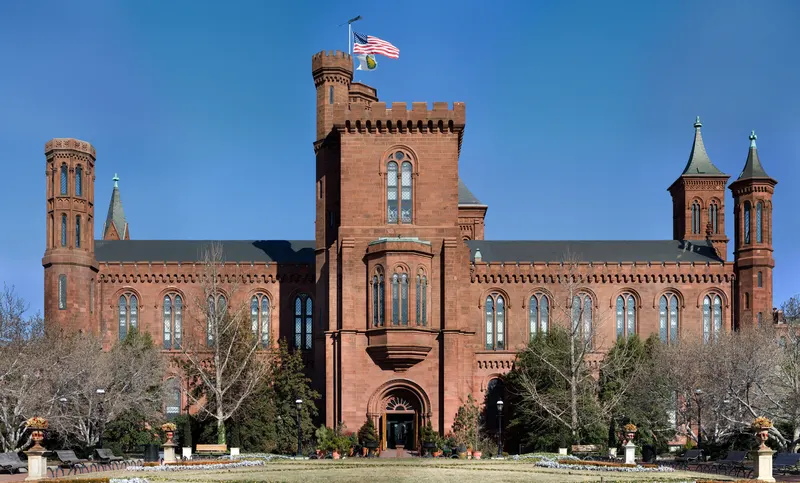
Air & Space sits on the south side of the National Mall, which shapes how you build the rest of the day. Its near neighbours on that side are the Hirshhorn's concrete drum, the curved sandstone of the National Museum of the American Indian — home to the Mitsitam Café, the best food on the Mall — and the red-sandstone Smithsonian Castle, the institution's visitor hub. That makes a natural south-side cluster: a morning under the planes, a regional lunch at Mitsitam, and an hour in the Hirshhorn or the Castle if you still have stamina.
Because the headline galleries take two to three hours, Air & Space works best as the anchor of a morning rather than a whole day. Reserve your timed slot for early, see the icons while you're fresh and the crowds are thinnest, then break for lunch off the lawn and let the afternoon stay loose. Save the monuments for the cooler edges of the day; the museum is the indoor anchor in the middle, and the Mall's open lawn is right outside when you need air.
Common questions
Is the National Air and Space Museum free? Yes — admission is free, like every Smithsonian museum. It does, however, require a free timed-entry pass reserved online.
Do I need a ticket or pass? Yes — reserve a free timed-entry pass ahead, especially in peak season. The pass costs nothing; verify the current requirement before you go.
What are the must-see objects? The 1903 Wright Flyer, the Spirit of St. Louis and Apollo-era spacecraft are the headline draws.
How long should I plan? About two to three hours covers the highlights; longer with children who fixate on the planes.
What is closed for renovation? The museum has reopened in phases, so the exact line-up shifts — check the current gallery map on the official site.
Should I go to the downtown museum or Udvar-Hazy? For a Mall-based trip, the downtown museum is the easy choice; Udvar-Hazy near Dulles is the bigger spectacle but far out of the city.

Related guides

Smithsonian Timed-Entry Passes
Which Smithsonian sites use free timed-entry passes, how the online releases and same-day batches tend to work, and which equally good museums to pivot to if your slot has gone.
Read guide
Natural History Museum Guide
How to visit the National Museum of Natural History on the Mall — the dinosaur hall, the Hope Diamond and the gem collection, the mammals and ocean halls, a family-pacing plan, where to eat, and how to see the highlights without museum fatigue.
Read guide
Washington, D.C. with Kids
Washington is one of the best-value family trips in America — free museums full of dinosaurs and rockets, monuments you can run between, a hillside zoo and wide-open lawns. This is a family-tested guide to things to do in DC with kids, with the museums that actually work, the parks and food breaks, and a sane way to pace it all.
Read guideMore in Things to Do
6
African American History Museum Guide
How to visit the National Museum of African American History & Culture on the Mall — the free timed-entry passes and how to get one, the deep underground history galleries, Sweet Home Café, the lines, how to pace an emotionally heavy visit, and the walk along the Mall.
Read guide
American History Museum Guide
How to visit the National Museum of American History on the Mall — the original Star-Spangled Banner, the First Ladies' gowns, the American presidency, the pop-culture icons, the food-court logistics, and how to time a visit around the school groups.
Read guide
Best Museums in Washington, D.C.
Washington has more world-class museums than any sane trip can hold, and almost all of them are free. This is a guide to the best museums in DC sorted by topic, age, ticket needs, location and rainy-day value — so you can choose two or three with confidence instead of trying to see them all.
Read guide
Best Photography Spots in Washington, D.C.
Where to make great photographs in Washington — the monument reflections, the Tidal Basin blossoms, the Capitol and Lincoln axis, Georgetown's waterfront, hidden rooftops and the golden-hour and blue-hour routes that tie them together.
Read guide
Best Things to Do in Washington, D.C.
A ranked first-trip shortlist of the best things to do in Washington, D.C. — from the National Mall and the free Smithsonian museums to a Capitol tour, the Tidal Basin and Georgetown — built so you can pick a handful and still feel you saw the city.
Read guide
Best Viewpoints in Washington, D.C.
Where to find the best views in Washington — the high monuments and free towers, the rooftop bars and cultural terraces, and the river and hilltop overlooks across the Potomac, ranked by how much effort each one asks.
Read guide