
DC Cherry Blossom Peak Bloom Guide
Exactly how peak bloom works in Washington — what 'peak' means, how the National Park Service forecasts it, why the dates move every year, and what to do if you arrive too early or too late. The practical answers to the question every visitor asks.

Photo: Meelika Marzzarella / Unsplash
- ✓'Peak bloom' is officially the day roughly 70% of the Yoshino cherry blossoms around the Tidal Basin are open — not the whole season, just that single high point.
- ✓It usually lands in late March or early April, but it has come as early as mid-March and as late as mid-April. Verify the year's NPS forecast.
- ✓The full-colour window lasts only about a week, and a storm of wind or rain can strip it early.
- ✓Watch the National Park Service bloom-watch and revise your plan as your trip nears — the forecast tightens through the season.
- ✓Arrive too early or too late and you still have options: the shoulder days, the later-blooming Kwanzan trees and the broader Washington spring.
What 'peak bloom' actually means
Peak bloom is a precise, official term, not a loose one. The National Park Service defines it as the day on which roughly 70% of the Yoshino cherry blossoms around the Tidal Basin are open. The Yoshino are the famous pale-pink trees that make up most of the canopy; when about seven in ten of their blossoms are out, the basin is at its fullest colour and the NPS calls peak bloom.
It helps to think of bloom as a process, not a switch. The NPS tracks the trees through a sequence of stages — green buds, florets visible, extension of florets, peduncle elongation, puffy white, and then peak bloom, after which the petals begin to fall. 'Peak' is one point near the top of that curve. There's beautiful colour for days on either side of it, so you don't need to hit the exact peak day to see the basin in bloom — you need to land somewhere in the window around it.
When does peak bloom happen?
Most years, peak bloom falls in late March or early April. But it genuinely moves: in different years it has arrived as early as mid-March and as late mid-April, a spread of several weeks. The driver is the winter and early-spring weather — a mild late winter warms the trees and pulls the bloom forward, while a cold snap holds it back. There is no fixed calendar date you can trust from one year to the next.
That's why the National Park Service issues a forecast and updates it as the buds develop through late winter and into spring. Early predictions are broad; the estimate tightens as the trees move through the bloom stages and the date nears. The single most useful habit for anyone planning around the blossoms is to check the official bloom-watch regularly in the weeks before a trip and adjust expectations as the forecast firms up.

How long does it last — and how do I time it?
The window of full colour is short — generally about a week — and it can be shorter still if the weather turns. The blossoms are delicate: a hard wind or a heavy rain at the wrong moment can knock the petals down and end the display almost overnight. So even a perfect forecast carries risk once the trees open, and the practical lesson is to favour flexibility over a single fixed date.
If you can, build a few flexible days into the trip and aim to be in town across a span rather than on one chosen day. Booking refundable accommodation, or dates you can shift, takes much of the gamble out of it. And if your dates are locked well in advance, accept that the bloom is a bonus rather than a guarantee — plan a trip you'll love regardless, and treat catching peak as the icing.

What if I'm too early or too late?
Missing the exact peak is not the disaster it feels like. Arrive a little early and you'll often catch the 'puffy white' stage or the first wave opening — a softer, still-lovely version of the display, with fewer crowds. Arrive a little late and there are usually petals still on the trees and a snow of them on the path and water, which photographs beautifully in its own right.
If the Yoshino are truly done, the deeper-pink Kwanzan cherries bloom roughly two weeks later and extend the season at the edges. Beyond the cherries, a Washington spring is full of colour — magnolias, tulips and dogwood across the parks and gardens — so a trip that narrowly misses the cherry peak still lands in a beautiful season. And the quieter bloom spots, the National Arboretum and Hains Point among them, can hold colour on their own timelines.

Peak bloom: quick answers
The questions visitors ask most, answered plainly — but the bloom moves every year, so verify the current NPS forecast before you commit.
- What is peak bloom? The day about 70% of the Tidal Basin's Yoshino blossoms are open — the single high point of the season.
- When is it? Usually late March or early April; possible from mid-March to mid-April depending on the winter weather.
- How long does it last? Roughly a week of full colour, less if wind or rain strips the petals early.
- How do I know the date? Check the NPS bloom-watch forecast, which is revised through the season as the buds develop.
- Can I plan a year ahead? Only loosely — book flexible dates or refundable rooms, and treat catching the exact peak as a bonus.
- What if I miss it? Aim for the shoulder days, look to the later Kwanzan trees, and enjoy the broader Washington spring.

Related guides

Washington, D.C. Cherry Blossoms Guide
When the Tidal Basin turns pink — how peak bloom works, the best routes and viewpoints, when to beat the crowds, the festival events, where to stay and the alternate bloom spots beyond the Tidal Basin. The complete guide to the DC cherry blossoms.
Read guide
Washington, D.C. in March
The month Washington wakes up — unpredictable weather swinging from late-winter chill to early spring, the all-consuming cherry-blossom watch, the first school groups and spring breakers, and the moment hotel rates and timed passes start to tighten. How to read March and plan around the gamble.
Read guide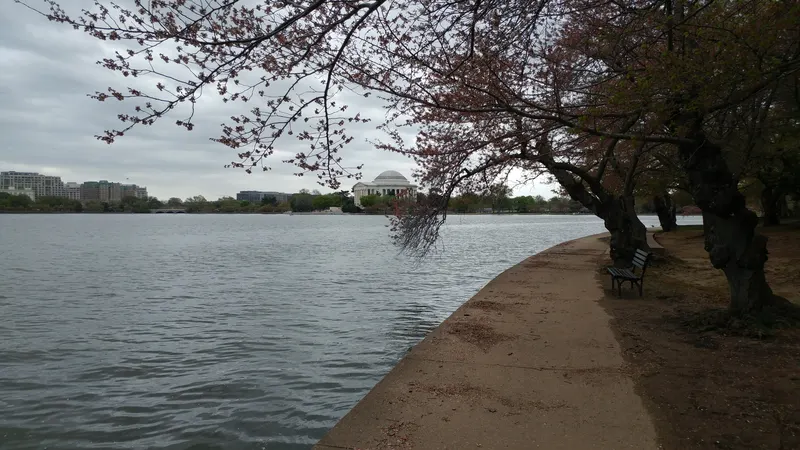
Tidal Basin Guide
Walk the Tidal Basin in Washington, D.C. — the Jefferson, FDR and Martin Luther King, Jr. memorials around its shore, the famous cherry blossoms, the paddle boats, the best time of day to beat the crowds, and where to stand for the sunrise reflection shot.
Read guide